
Sarah Byer and John Giulewicz | Claims Journal
Living in the northeast, ice dams are a part of life, and a common cause of loss in the insurance industry. However, they are often misunderstood, and effective remedies can be elusive. It’s essential for insurance and claims professionals who may deal with ice dams in their work lives to know what ice dams are, why they occur, how to identify them and the damages they can cause.
Industry data from a Guidewire HazardHub analysis underscores the scope of the issue, with estimates that nearly one-third of U.S. homes, roughly 31.4 million housing units, are in areas with more than 30 freezing days a year, making ice dam formation more of a widespread risk across the country they many may have believed to be the case.
What Is An Ice Dam, And Where Do They Occur?
An ice dam is a build-up of ice along the eave of a roof. The ice can continue to build up on the roof surface and extend from the eave part way up the slope of a roof, depending on climate conditions prior to and during the process.
According to the University of Minnesota: There must be snow on the roof, and, at the same time, higher portions of the outside surface of the roof must be above 32°F while lower surfaces are below 32°F for ice dams to form. “For a portion of the roof to be below 32°F, outside temperatures must also be below 32°F. When we say temperatures above or below 32°F, we are talking about average temperature over sustained periods of time. The snow on the roof surface that is above 32°F will melt,” the University of Minnesota explanation continues. “As water flows down the roof, it reaches the portion of the roof that is below 32°F and freezes. Voila! – an ice dam. The dam grows as it is fed by the melting snow above it, but it will limit itself to the portions of the roof that are on average below 32°F. So, the water above backs up behind the ice dam and remains a liquid. This water finds cracks and openings in the exterior roof covering and flows into the attic space. From the attic it could flow into exterior walls or through the ceiling insulation and stain the ceiling finish.”
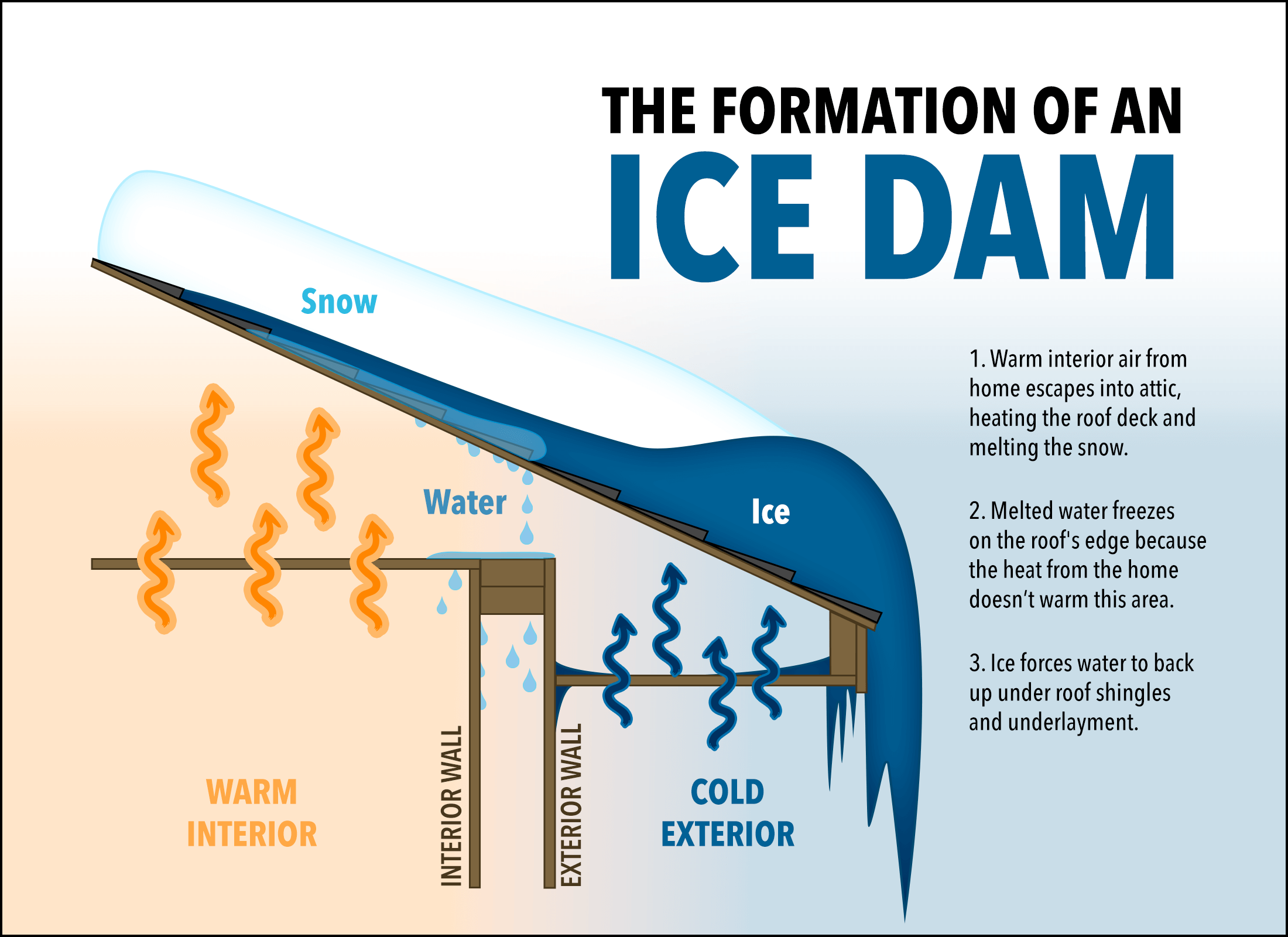
It’s helpful to take a glance at the illustration (Anatomy of an ice dam). Note that ice dams form only along the exterior walls of a structure during sustained below-freezing temperatures. The water that will migrate into the building will only do so along the exterior wall, and not to interior portions of rooms and interior walls remote from roof eaves. In addition, the damage is most likely to be found at or near the upper portion of the wall where it meets the ceiling, but may extend down the wall and even into the basement.
Where Does The Heat Come From That Melts The Snow?
The melting of snow on the upper slopes of the roof can be caused by several heat sources. The most common source is daytime temperatures above freezing, often combined with sunlight, which melt snow during the day. As the water flows toward the eaves and gutters, it can refreeze as temperatures drop in the late afternoon and evening. This cyclical phenomenon is one of the leading causes for the formation of ice dams. Another culprit is heating loss through the roof itself. Inadequate insulation or poor ventilation allows warm air from inside the home to rise into the attic, warming the underside of the roof and melting the snow.
Will Heat Cables Fix The Problem?
The definitive answer is…maybe. Heat cables are commonly used to alleviate the occurrence of ice dams by generating heat along the eaves during times when below freezing temperatures occur. This melts the snow and ice along the eaves, allowing it to run off the roof, but the water often refreezes lower on the roof, in the gutters or downspouts, creating backups that block further drainage. If this occurs, the snow and ice will continue to back up onto the roof, despite the presence of the heat cables. This problem could also be compounded if the cables fail, the automated thermostat fails or if the homeowner forgets to turn them on when manually controlled.
What About Using Ice Shields?
Ice shields are usually made of a waterproof membrane with a modified bitumen backing covered with a release film. The film is peeled away when the ice shield is applied to the roof so that it is securely adhered to the roof sheathing. When properly installed, it forms watertight end and side laps. The modified bitumen forms a waterproof seal around the nail penetrations when shingles are fastened over the top of the ice shield. So, following manufacturer installation requirements is important, and in some cases, an ice shield is installed over an entire roof. Care should be exercised when this is done to ensure that proper ventilation is maintained to protect the life of the roof. Ice shields are very effective in reducing the likelihood of ice damage and also help in the event of high winds where shingles may be damaged along the eaves, a location where wind speeds are often the highest. While ice shields will not preclude the occurrence of ice dams or ice damming, they will help eliminate or reduce the interior moisture damage that can result. In addition, some state and local building codes now require the installation of ice shields or barriers.
Are There Tell-Tale Signs of Ice Dams?
One exterior tell-tale sign is the presence of icicles. While this is not a guarantee that there is ice damming, it is proof that snow is melting on the roof and refreezing and is justification for further investigation.
What Types of Damages Can Ice Dams Cause?
Interior: Inside the house the most common damage caused by ice dams is moisture staining to finishes and wet insulation at the intersection of an exterior wall and the adjacent ceiling. This typically occurs where a portion of the roof surface extends past the exterior of the house, or beyond the heated building envelop. Interior damages may appear minor, often just stains or damp insulation, but the costs can add up quickly. According to data from JMI Reports, the average settlement following an ice dam claim is $8,000, and that only covers interior damage, not exterior repairs.
Interior moisture issues will be concentrated along the exterior walls at the roof eaves while the building walls below the gable ends of the roof (defined as the rake edge) would not be expected to suffer ice dams and the resulting interior moisture stains. Furthermore, if the staining is in the middle of a room or far above the eaves or roof edges, it is most likely not due to ice damming. Consider the time of year and weather conditions around the time of loss. If the stains appear in July, there is likely another cause such as failed roofing or wind driven rain. If it is during the winter months or the shoulder seasons of later fall or early spring, it may well be due to ice damming.
Exterior: At the exterior, ice dams can cause gutters, fascia and soffit trim to detach or be ripped from the roof edge due to the weight of ice and snow that can build up in the gutters. However, ice dams alone rarely damage asphalt shingles. More often, those issues stem from contributing factors like age-related deterioration or wind damage.
As noted earlier, ice dams can cause snowmelt moisture to infiltrate the inside of the home. Asphalt shingles are not waterproof; they rely on roof slope and gravity to shed water. When water is trapped, it can back up under the shingles and enter the home. In EFI’s experience, a common cause of damage to shingles is homeowners or roofers who attempt to remove the ice dams with tools that often will scratch, tear or puncture the shingles.
Given the frequency of ice dams, particularly in the northeast, they should not be taken lightly. Careful consideration of the evidence is warranted, and an evaluation is often beneficial to both the insurer and the insured.
When one of your cases is in need of a construction expert, estimates, insurance appraisal or umpire services in defect or insurance disputes – please call Advise & Consult, Inc. at 888.684.8305, or email experts@adviseandconsult.net.